
Mutual Fund Return Calculator
An interactive financial tool designed to estimate the future growth of your one-time lump sum mutual fund investments in Rs. Track wealth generation and compounding milestones with absolute clarity.
Table of Contents
Lumpsum Mutual Fund Calculator
Amount Invested:
Est. Returns (Wealth Gain):
Total Expected Value:
Amount Invested vs Returns Allocation
Total Estimated Value:
| Duration | Invested Amount (Rs.) | Future Value (Rs.) |
|---|
Try Other Calculators
Introduction
If you are sitting with a lot of money that you are not utilizing, the first thing you will need to do is make use of a lumpsum mutual fund calculator before investing any amount. This will help you determine how much your one-time investment will grow within seconds.
Our Lumpsum Mutual Fund Return Calculator at WealthCalculatory provides you with all sorts of inputs required to calculate your corpus growth in one go, including your investment amount, annual return expectations, investment period, and inflation.
Once you input all these details, you get a total of your corpus gain along with a yearly projection table that can be downloaded in PDF format.
Here, we will discuss everything you should know about using this calculator, its input requirements, returns calculation, and interpretation of results.
What is a Lumpsum Mutual Fund Return Calculator?
What is really a lumpsum mutual fund Return calculator? It is a free calculator available online that will help you compute the future value of a one-time mutual fund investment. Unlike a SIP calculator that computes the annual interest on a periodic (monthly) basis, the lumpsum Mutual Fund Return calculator will estimate a one-time investment.

It is simple enough to understand why we need a separate calculator for the purpose. The whole principle behind the working of the Mutual Fund Return calculator is that the entire investment amount starts to compound immediately.
In other words, whatever gains you make each year will be added to the total investment and then again the gains will be computed on this compounded value each year. And, the gains each year grow bigger than the previous year’s because of the magic of compounding.
An interesting feature of the WealthCalculatory lumpsum Mutual Fund Return calculator is the option to calculate inflation rate. This feature has been deliberately left out by most competing calculators.
How Does the Calculator Work?
The structural architecture relies on baseline parameters supplied directly by the user:
- Total Investment (Rs.): The gross one-time capital baseline allocated directly on day zero.
- Expected Annual Return Rate (%): The portfolio’s planned annualized internal target or historical compound framework.
- Investment Period: The continuous layout duration in years where the compounding principal remains untouched.
- Inflation Adjustment (Optional): Scales the final wealth estimations to provide true values anchored to modern purchasing constraints.
Formula to Calculate Mutual Fund Return
The WealthCalculatory lumpsum mutual fund Return calculator uses the standard compound interest formula:
Where:
- A: Future value of your investment (the final corpus)
- P: Principal amount invested (your one-time lumpsum)
- r: Expected annual return rate expressed as a decimal (e.g. 12% = 0.12)
- n: Number of years invested
Accounting for Inflation
When inflation adjustment is applied, the formula adds one more step:
This tells you what your projected corpus is actually worth in today’s money, accounting for the fact that Rs. 1 crore in 2044 will not buy the same things as Rs. 1 crore today.
Practical Example
If you invest Rs. 5,00,000 today at a 12% annual return for 15 years:
Your Rs. 5 lakh grows to over Rs. 27 lakhs, without investing a single rupee more.
Now apply a 6% inflation adjustment:
This means your Rs. 27 lakh corpus has the equivalent purchasing power of Rs. 11.44 lakhs today. That is still more than double your original investment in real terms, but the inflation-adjusted view helps you plan more accurately for your actual future needs.
How to Use the Lumpsum Mutual Fund Calculator
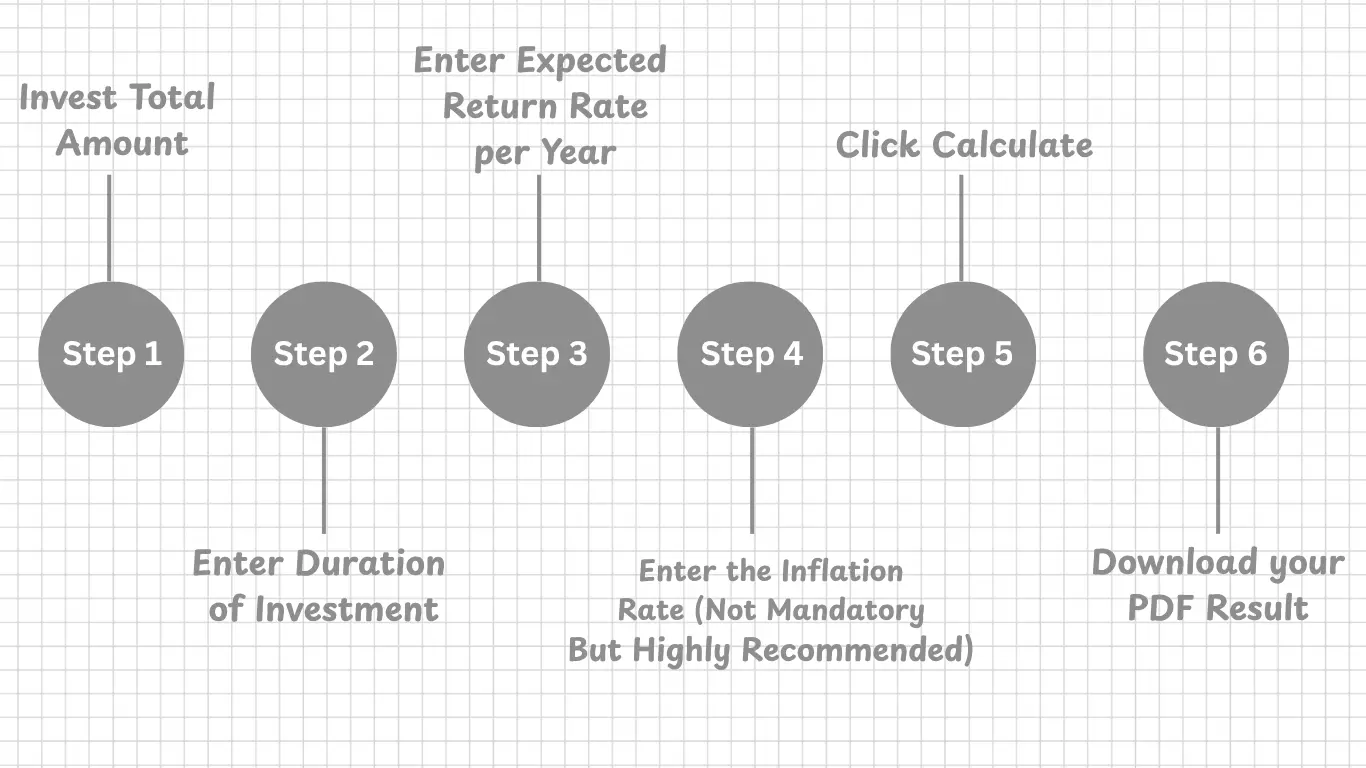
To use the WealthCalculatory calculator, it takes less than 60 seconds. This is how:
Step 1: Invest Total Amount
Enter the single amount that you wish to invest. It could be Rs. 5,00,000 earned via bonuses, inheritance, savings, or anything else.
Step 2: Enter Duration of Investment
How long do you wish to remain invested in the investment plan? Ideally, if your investment scheme is an equity mutual fund, you should stay invested for at least 5 years. However, for creating real wealth, it should be 10 to 20 years.
Step 3: Enter Expected Return Rate per Year
It is the most crucial step. Use realistic figures based on the mutual fund category that you are planning to invest in. In conservative assumptions, you may use 10% to 12% return rate for equity funds.
Step 4: Enter the Inflation Rate (Not Mandatory But Highly Recommended)
Insert the average inflation rate of around 5-6% to know the actual buying power of your future corpus. An option that most calculators do not provide.
Step 5: Click Calculate
The result will be generated immediately, investment summary, total wealth generated, a donut graph, and the entire annual table too.
Step 6: Download your PDF Result
By clicking on the Download Result option, you can download a PDF of your result.
Year-by-Year Projection | What the Table Shows You
One of the best benefits of using the WealthCalculatory lumpsum Mutual Fund Return calculator is the table of progress. It does not just tell you where you end up; it tells you where you are along the way.
Below is an example of projections made on an investment of Rs. 5,00,000 at 12% per year:
| Duration | Amount Invested (Rs.) | Future Value (Rs.) |
|---|---|---|
| 1 Year | Rs. 5,00,000 | Rs. 5,60,000 |
| 3 Years | Rs. 5,00,000 | Rs. 7,02,469 |
| 5 Years | Rs. 5,00,000 | Rs. 8,81,171 |
| 8 Years | Rs. 5,00,000 | Rs. 12,37,866 |
| 10 Years | Rs. 5,00,000 | Rs. 15,52,924 |
| 15 Years | Rs. 5,00,000 | Rs. 27,36,789 |
| 20 Years | Rs. 5,00,000 | Rs. 48,23,150 |
| 25 Years | Rs. 5,00,000 | Rs. 85,00,050 |
| 30 Years | Rs. 5,00,000 | Rs. 1,49,79,502 |
Note the change from Year 20 to Year 30. The corpus increases almost three-fold just during this last decade! This is the power of compounding at work, the more time that passes by, the faster your money grows!
Lumpsum vs SIP Comparison
The choice of your calculator rests completely on how you earn and the associated risks. This is the most ignored comparison in finance sites. Try out our free SIP Calculator now!
| Parameter | Lumpsum Investment | SIP Investment |
|---|---|---|
| Investment Style | Entire investment made in one shot | A fixed amount per month |
| Compounding Advantage | Complete corpus gets compounded from day one | Compounding happens individually |
| Rupee Cost Averaging | NA, only single entry point | In-built, purchase price is averaged |
| Market Timing Risk | Very high, timing is crucial | Very low, spread over many months |
| Ideal Market Conditions | Market correction or low valuation | Any kind of market |
| Most Suitable For | Income from bonus/windfall/surplus | Salaried income earner |
| Minimum Investment Amount | Rs. 5,00,00 or higher | Rs. 100 per month |
| Emotion Required | Very High, difficult to resist selling during panic | NA |
The important point ignored by most calculators: Lumpsum may not be better than SIP in all situations. In case of an increasing market, lumpsum is better because you get to invest the entire corpus at the beginning. In case of a volatile or decreasing market, SIP is better because of rupee cost averaging.
The Inflation Adjustment Feature | Why It Matters
The majority of lumpsum calculators available in India simply provide you with the gross estimated corpus. The WealthCalculatory calculator comes with an inflation adjustment field – and this has great importance in your planning process.
This is how this affects the results in figures:
No inflation adjustment: ₹5,00,000 invested at 12% for 20 years = ₹48,23,150
With 6% inflation adjustment: The purchasing power of this ₹48 lakhs adjusted to current currency = ₹15,03,487
As you see, the gap between the ₹48 lakhs and ₹15 lakhs illustrates the way inflation reduces a substantial amount of your estimated wealth. If you need ₹1 crore in current currency at retirement, your real goal corpus should be larger than that.
Use the inflation adjustment field in all your calculations concerning long-term goals including retirement, children’s education, and housing purchases. You do not have to worry about this with regard to short-term goals of 1 to 3 years.
Common Mistakes to Avoid When Investing Lumpsum
While a lumpsum mutual Fund Return calculator shows you the ideal mathematical path to wealth creation, real-world returns can be easily derailed by a few common investor missteps. Here is what you need to avoid:
01. Using an Unrealistic Rate of Returns
Even if it feels optimistic, using 18% or 20% in the calculator will only set yourself up for a disaster. Stick to realistic, history-backed numbers: use between 10% and 12% for equity mutual funds and between 6% and 7% for debt instruments.
02. Investing Lumpsum During Times of Record Highs
This is by far the biggest danger of investing a large single amount. While trying to perfectly time the market is impossible, you can manage this risk: choose to divide your lumpsum into 3 to 6 parts and invest them systematically over a period of 3 to 6 months.
03. Making an Early Withdrawal During Market Dips
Investing a lumpsum into equities that drop 25% after two years is not a problem, unless you panic and withdraw. Holding on tightly to your investments during temporary market dips is precisely what earns you the long-term compounding returns promised by the calculator.
04. Not Taking Inflation Into Account
If you target a milestone of Rs. 50 lakhs in 20 years without considering inflation, you are actually planning for a corpus that will feel like just Rs. 15-20 lakhs in today’s purchasing power. To get a realistic view, always use the built-in inflation adjustment feature.
05. Ignoring Expense Ratios
An actively managed fund with an expense ratio of 1.5% compared to a 0.5% low-cost index fund might not look huge in percentages. However, when you invest Rs. 10 lakhs over 20 years, that slight 1% difference chunks away a massive Rs. 8-12 lakhs from your final wealth generation table.
Conclusion
A lumpsum mutual fund investment is one of the strongest ways to grow wealth in India, but only if done with clarity and patience. The WealthCalculatory Lumpsum Mutual Fund Return Calculator has all the tools you will need to make such a decision in an informed manner.
Just input your values, view your estimates, factor in inflation, print out your PDF report, and take an informed decision.
Disclaimer
All tools on this website are for informational and estimation purposes only. The results you see are based strictly on your own inputs, not guaranteed outcomes. Real financial results may vary significantly depending on market conditions and individual circumstances. We do not offer financial advice. Please consult a certified Financial Adviser before making any financial decision. Read our Privacy Policy & Terms of Service.